
ICELAND WITHDRAWS FROM EUROVISION AMID GROWING BOYCOTT OVER ISRAEL'S INCLUSION
- Oasis FM
- 11-12-2025
- Showbiz News
- Photo Credit: Wikipedia

In a major blow to the upcoming Eurovision Song Contest, Iceland has officially announced it will boycott this year’s event in protest over Israel’s participation. The decision marks one of the most significant withdrawals so far and signals growing unrest among European broadcasters as tensions surrounding the contest continue to escalate.
The move comes shortly after the European Broadcasting Union (EBU) confirmed that Israel would be permitted to compete, despite intense public and political pressure calling for the country’s exclusion. The ruling has ignited fresh debates and prompted several nations to reconsider their involvement in the iconic 69-year-old contest.
Iceland is now the latest country to join the boycott, following similar decisions by Ireland, the Netherlands, Spain, and Slovenia. The momentum behind the withdrawal appears to be increasing, with other broadcasters expected to follow suit.
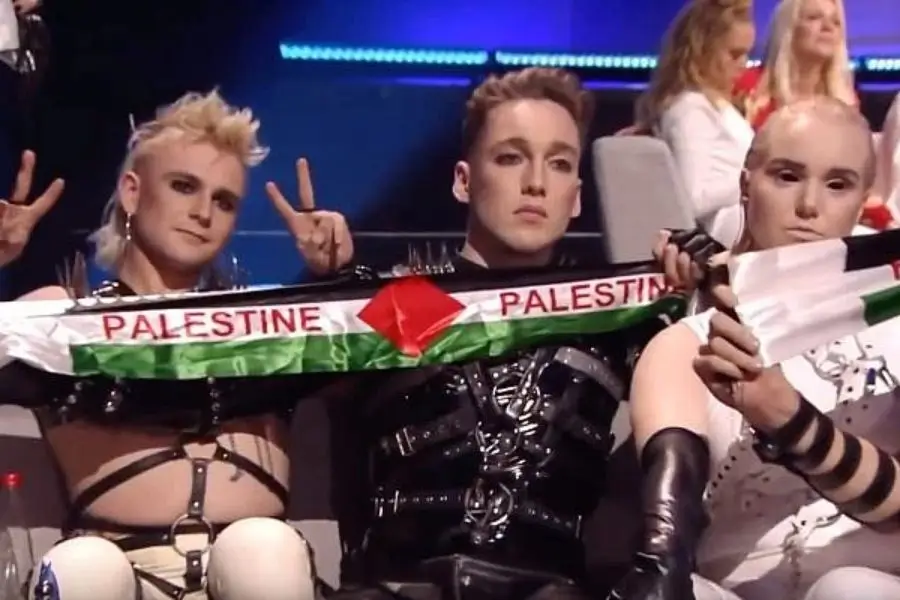 Icelandic band Hatari hold up Palestinian flags during the live grand final of the Eurovision in Tel Aviv, May 19, 2019 – Credit: Screenshot/YouTube
Belgium’s national broadcaster revealed this week that it will “take a position in the coming days,” sparking speculation that it may become the next country to step aside. Industry insiders suggest that additional nations are engaged in internal discussions regarding the future of their participation.
What began as a small-scale protest has evolved into a potentially historic standoff between Eurovision’s organisers and its member countries, one that could dramatically reshape the 2026 contest.
The roots of the conflict stretch back to earlier this month, when representatives from several countries attended the EBU’s general assembly in Geneva. There, they voted on changes aimed at preventing coordinated public voting campaigns, a direct response to concerns surrounding the unusually high level of public votes Israel received in the 2025 contest.
Broadcasters have argued that the public voting system has become vulnerable to organised online movements, calling into question the integrity and fairness of the competition. While the EBU insists its voting system is secure and transparent, many countries remain unconvinced.
Iceland’s broadcaster described the situation as “untenable,” emphasising that participating under the current circumstances would be incompatible with the nation’s values and public sentiment.
Eurovision has faced political tensions before, but this growing boycott threatens to overshadow the spirit of unity and cultural celebration that has long defined the contest. With five countries already stepping back, and potentially more on the horizon, this year’s event may see its most fractured lineup in decades.
Fans across Europe have taken to social media to voice their disappointment, frustration, and in some cases, support for the broadcasters choosing to withdraw. While many Eurovision enthusiasts insist the contest should remain apolitical, others argue that involvement is inherently tied to global political climates.
The EBU has yet to comment on Iceland’s withdrawal but is expected to release a statement in the coming days as pressure mounts. Meanwhile, participating countries continue their preparations, albeit under a cloud of uncertainty.
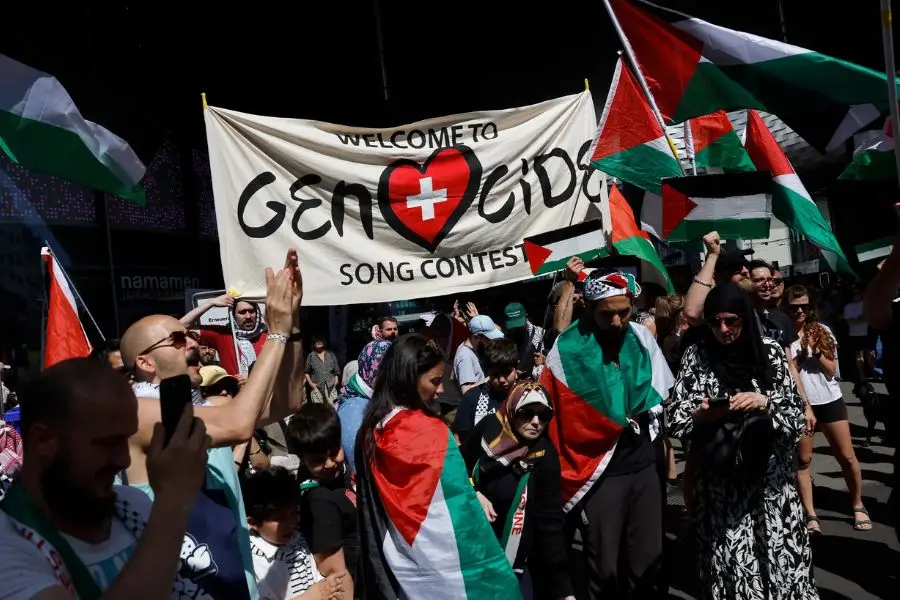 Protesters hold a banner and Palestinian flags as they take part in a demonstration against Israel’s candidate during the Eurovision Song Contest 2025 opening ceremony in Basel on May 11, 2025 - Stefan Wermuth/AFP
If additional nations join the boycott, it may force the EBU to reconsider its decision or risk hosting a significantly reduced contest.
For now, Eurovision 2026 looks set to be one of the most divisive chapters in the competition’s history.
trending